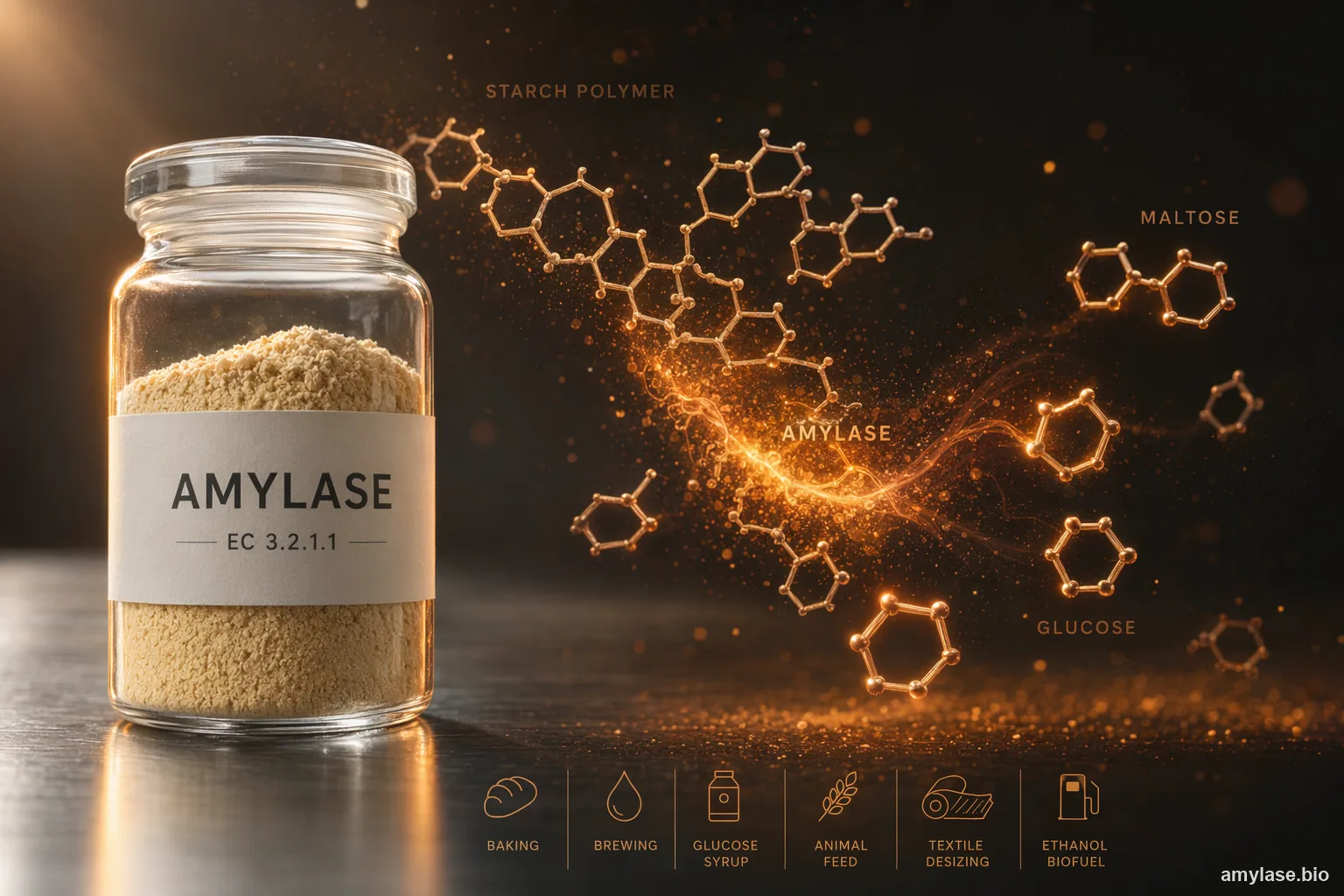
Amylase for Cereal Cooker Liquefaction and Mash Starch Conversion
Thermostable amylase in bulk for breweries and brewing-ingredient distributors: liquefies corn, rice or sorghum in the cereal cooker so the combined mash converts fully. Quoted per order, by the drum or jerrican.
Brewing with unmalted grains such as corn grits, rice, or sorghum alongside malted barley is standard practice in large-scale lager and ale production. These adjuncts provide fermentable extract at lower cost than malt, but they arrive with little or no endogenous enzyme activity of their own. When adjunct levels exceed 20–30% of the grist, malt enzyme levels can become insufficient to fully convert the total starch load, leaving residual starch that impairs filtration, reduces fermentable extract yield, and creates haze stability problems in finished beer.
Amylase added at the cereal cooker and in the mash addresses this directly. Adding exogenous amylase enzyme alongside malt enzymes in the mash provides additional alpha-amylase activity to liquefy adjunct starch and contribute to overall dextrin breakdown, and additional beta-amylase equivalent support through saccharification temperature steps. This allows brewers to push adjunct ratios higher — up to 40–50% in some industrial lager systems — without sacrificing conversion efficiency, wort flow, or fermentable sugar profile.
What a beer-grade cooker enzyme looks like in practice: thermostable liquids sold for the beer cereal cooker are commonly made with Bacillus licheniformis and labelled for about 85–100°C with an optimum near 95–97°C, and pH 5.0–9.0 with an optimum near 5.5–6.0. Their dose is usually set on the adjunct, not on the whole grist: for example 0.02–0.05% of adjunct dry weight, or 0.2–0.5 L per tonne of adjunct. So compare offers on the same basis: a dose per tonne of adjunct cannot be set against a dose per tonne of total grist. A cooker grade does the liquefaction step only; ask which job each product is sold for. These figures describe common practice, not our own grades: we supply an Aspergillus oryzae grade for mash temperature programmes and a Bacillus subtilis grade for the hotter cooker step; ask for the TDS of the grade you are quoting.
For breweries and brewing-ingredient distributors we quote per order: MOQ 25 kg, packed in 25 kg fiber drums or 30 kg jerricans. Buyers usually check fit with their cooker and mash temperature programme, lot-to-lot activity consistency, and documentation for food-grade use; we supply COA, TDS, and food-grade certification per lot. To request a quote, send the adjunct type and its share of the grist, the quantity per order or per year, and the delivery country.
Corn Grits Adjunct Mashing
Corn grits are gelatinised in a cereal cooker at 90–100°C with a thermostable amylase dosed on the grits' dry weight to begin starch hydrolysis and reduce viscosity before mash mixing. After the cooker hold, the liquefied adjunct is mashed-in with the malt portion at 63–68°C. This prevents the adjunct from diluting malt enzyme activity below the threshold needed for complete conversion, particularly important when corn comprises 30–50% of total grist.
Rice Adjunct Mashing
Rice starch gelatinises at 68–78°C, requiring a high-temperature cooker step before mash-in. A thermostable amylase is added to the rice slurry in the cooker to begin viscosity reduction, dosed on the rice's dry weight. The liquefied rice is then combined with malt in the mash tun at 63–66°C. Rice-adjunct beers benefit from amylase supplementation to maintain consistently fermentable wort, particularly when rice exceeds 20% of grist and malt enzyme load is at its practical limit.
Sorghum Beer Production
Sorghum-based opaque beers and lagers in African markets often use 100% sorghum grist, with no malt enzymes to rely on. Exogenous amylase (alpha and beta blend) is essential for starch conversion in these all-sorghum mashes. Operating at pH 5.0–5.5 and 55–65°C during the saccharification rest, amylase converts sorghum starch into a fermentable wort. Dosage depends on the enzyme mix, its stated dose basis and the target fermentable extract, so it is set by trial brew.
High-Adjunct Industrial Lager
Large-scale industrial lager production with 40–50% adjunct (corn or rice) uses exogenous amylase to supplement malt enzymes throughout the mash. This enables consistent extract yield, stable fermentation performance, and predictable FAN (free amino nitrogen) levels even as grist composition varies with crop season. Liquid amylase is preferred for inline injection into the mash tun or kettle, with dosage metered by process control systems calibrated to activity per mL.
| Parameter | Value |
| Activity range | 10,000 – 100,000 U/g (multiple grades) |
| Optimal pH | 5.0 – 6.2 (mash range) |
| Optimal temperature | 60°C – 90°C (grade dependent) |
| Form | Light yellow to brown powder or liquid |
| Shelf life | 12 months (sealed, cool, dry place) |
| Packaging | 25 kg fiber drums / 30 kg jerricans |
Frequently Asked Questions
How much amylase enzyme should I add for adjunct mashing?
Start from the label and its basis. A beer-grade thermostable liquid for the cereal cooker is typically labelled per unit of adjunct, for example 0.02–0.05% of adjunct dry weight (0.2–0.5 L per tonne of adjunct) on one such grade, while other products state a dose per tonne of total grist or by powder weight. Convert every offer to the same basis before comparing price. In combined malt-adjunct systems, malt provides background amylase activity, so the cooker dose and any mash-in addition are set by adjunct percentage, malt enzyme level, mash temperature programme and target fermentable extract. Trial brew evaluation is recommended before commercial deployment.
Which amylase grade is best — Aspergillus or Bacillus?
For mash saccharification at 62–68°C and pH 5.2–5.5, Aspergillus oryzae–derived amylase performs well and is active across the saccharification temperature range. For adjunct cooker steps at 80–95°C, the Bacillus subtilis–derived thermostable grade is essential, as fungal amylase loses activity rapidly above 70°C. Many adjunct breweries use both: Bacillus grade in the cereal cooker and Aspergillus or Bacillus standard grade at mash-in. Contact us for grade recommendations based on your mash temperature programme.
Will exogenous amylase affect beer flavour or haze?
When dosed correctly, exogenous amylase improves conversion completeness, which reduces residual dextrin and ungelatinised starch — both of which can contribute to chill haze and filtration difficulties. Amylase does not generate off-flavour compounds. The key is avoiding overdosing that produces excessive short-chain dextrins, which can affect beer body. Used at the recommended dosage for your grist composition, amylase supplementation improves wort quality without negative sensory impact.
Can I use amylase with other exogenous brewing enzymes?
Yes. Exogenous amylase is frequently combined with glucoamylase (for ultra-light beer fermentability), pullulanase (for debranching), beta-glucanase (for barley or oat mashes), and protease (for improved FAN). These enzyme combinations are compatible in the mash and can be dosed separately or as a pre-blended mash enzyme cocktail. We can supply amylase for your existing enzyme programme or advise on a combined enzyme strategy for your specific grist composition.
Request a Brewery Quote and Dosing Basis
Send three things: the product or grade (alpha or beta, Aspergillus or Bacillus, powder or liquid), the quantity per order or per year, and the destination country. Add your application and target pH/temperature window if you know them. We'll match the grade, send a free 100 g sample with COA and quote bulk pricing within 24 hours.
Request a QuoteRequest a Brewery Quote and Dosing Basis
We have received your message. We will reply by email.
Or email hello@mail.amylase.bio